Positive economic news buoys Iran’s new president ahead of UN visit
Iran’s new president, Masoud Pezeshkian, is in New York this week to attend his first UN General Assembly meeting. His foreign policy team, led by foreign minister Abbas Araghchi, is with him hoping to resurrect the all-but-dead nuclear talks. Pezeshkian’s success in his first term depends on easing, if not ending, US sanctions. In seeking talks with the West, two recent pieces of positive economic news help dispel the notion that Iran is seeking to resume negotiations because its economy is tanking. They will not convince those who wish to interpret Pezeshkian’s election and his reaching out to the West as signs that sanctions are finally doing their wrecking job and it is therefore time to wait as Iran’s position softens. But, for the record, there is some positive news.
Two key economic indicators bolster Iran’s position as it engages with skeptical Western diplomats:
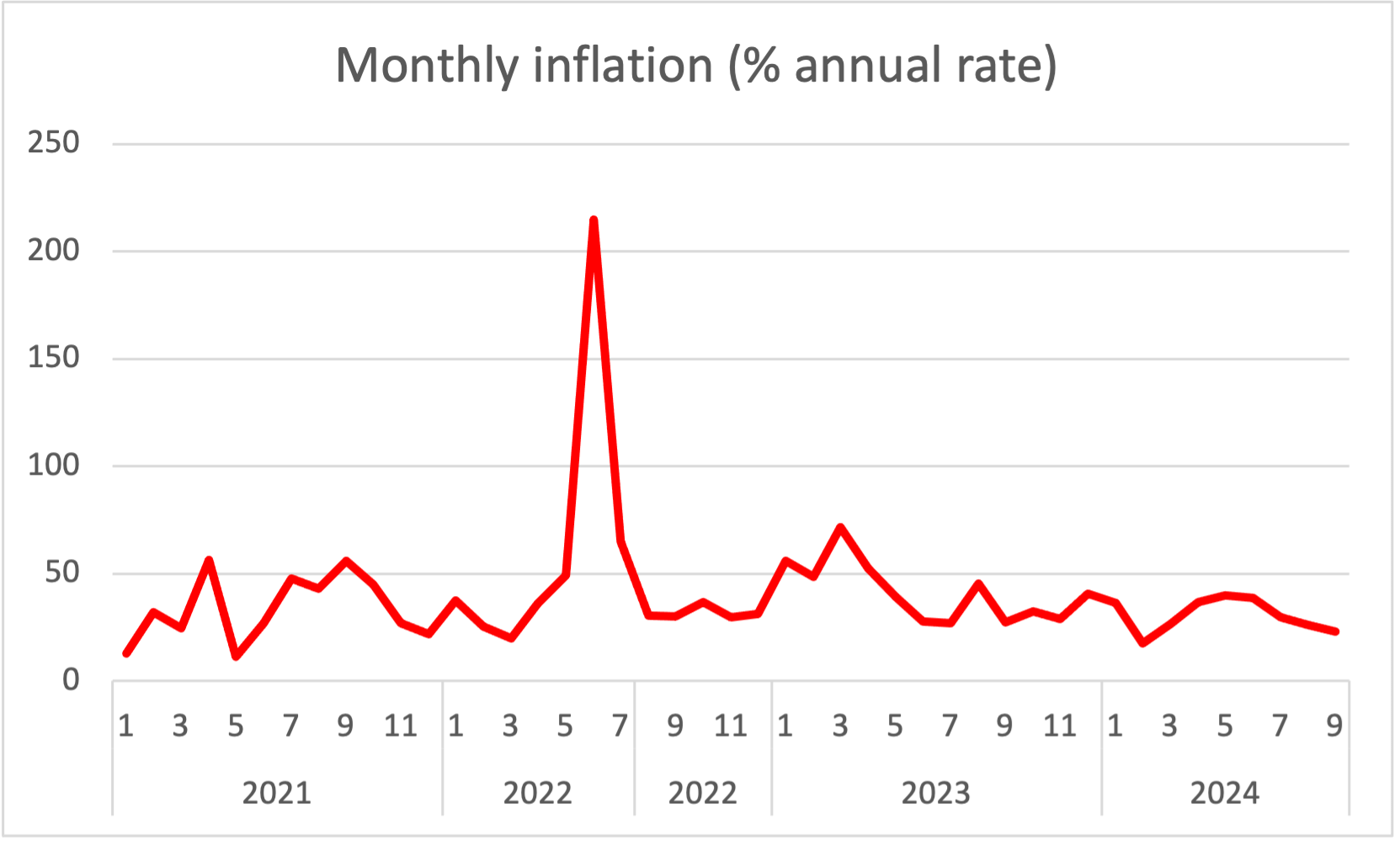
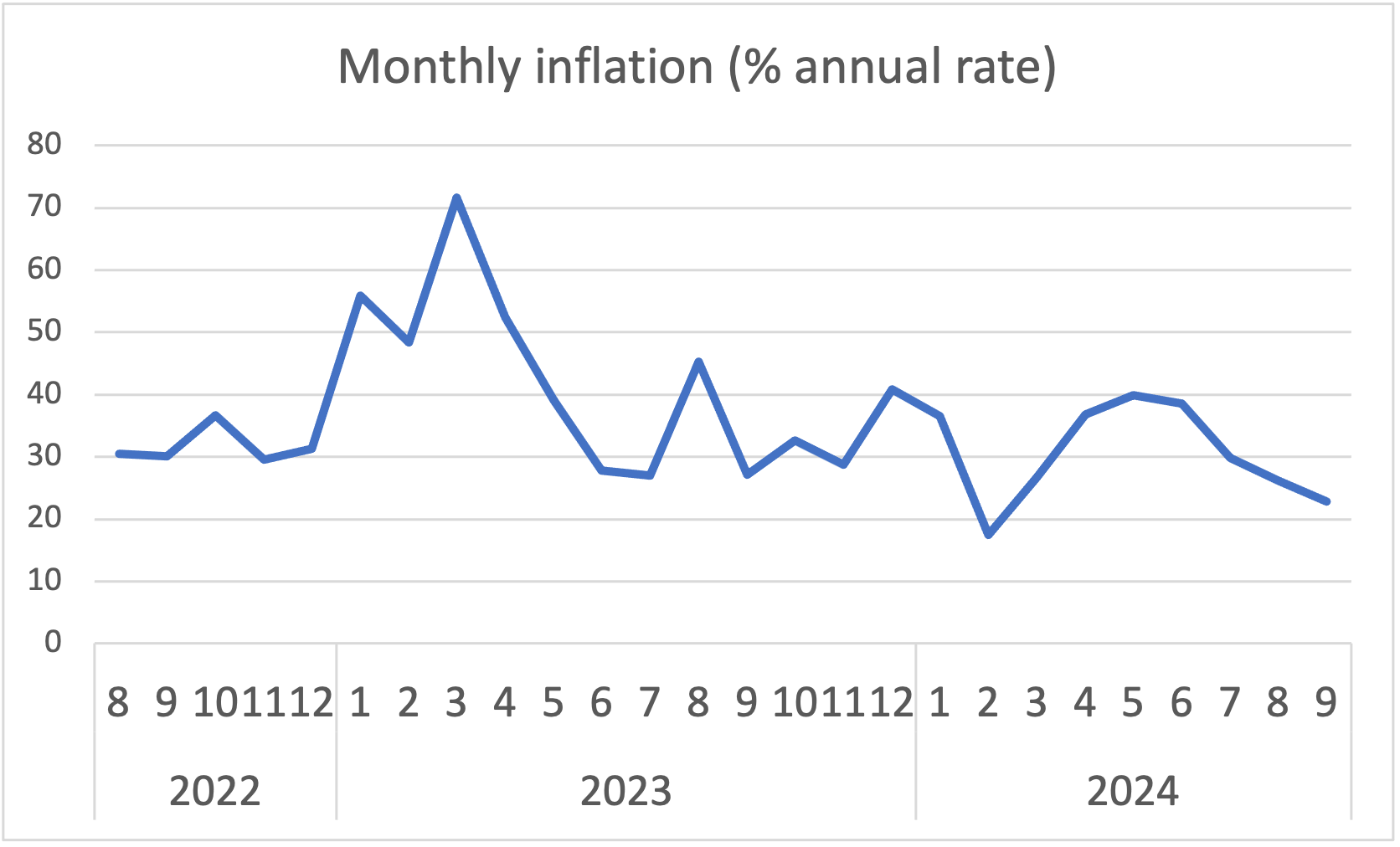
- Inflation: Last month (the Iranian month ending September 20), prices rose at a 22% annual rate, marking the third consecutive month of inflation below 30%.
- Economic growth: Despite sanctions, Iran’s economy grew by 4.5% in the 2023/24 Iranian year and by 3.3% during spring this year.
To appreciate why a 22% inflation can be good news, consider that less than two years ago, in June 2022, prices surged at a record annual rate of 214% (Figure 1, left panel) following the removal of the exchange rate subsidies. As recently as 18 months ago, inflation was still above 50% annually (see the right panel). The crucial question now is what factors are driving this slowdown. Possible explanations include tight monetary policy (which has frozen real estate transactions), rising supply of foreign exchange (oil production was up), and improved budget discipline. Understanding which of these factors played a role will indicate whether the slowdown is likely to continue.
Turning to economic growth, the reasons behind the modest recovery are equally unknown. The Central Bank report containing the new economic data recites the numbers without providing in-depth analysis. Available figures suggest that, as in the past three years, growth has been led by the oil and gas sector, which expanded by 14.7% last year and 9.5% in spring. Manufacturing has been also growing, but slowly and not commensurate with the stimulus it has received from currency depreciation — up by 4.4% last year and 3.1% last spring. Non-oil GDP grew by 3.6% last year and 2.5% in spring.
No one should expect the election of a moderate Iranian president or signs of continued economic recovery in Iran to signal an imminent end to decades of hostilities between Iran and the West. This is particularly true with ongoing conflicts in Ukraine and Palestine, where the two sides are at odds. However, it does prompt a reevaluation of continued reliance on the West’s favorite weapon — sanctions — to persuade Iran to halt its nuclear enrichment or to cooperate with the West in promoting regional stability.
Correction made on 9/26/24: 2022/23 changed to 2023/24 for GDP growth, in second paragraph.
The real depreciation of the rial under sanctions
In my previous post I argued that sanctions and the multiple devaluations they have caused have increased the competitiveness of the Iranian economy. This means that inflation did not increase enough to undo a series of devaluations since 2011, so that the rial is cheaper in real terms, not just nominal terms. If this is the case, removal of financial sanctions confer important benefits on Iran, perhaps exceeding that of the release of frozen funds or more oil sales to China. Below I present the evidence of rial’s devaluation in real terms and leave the question of its potential for growth of non-oil exports to another time.
(more…)Iran’s recent economic growth explained in four graphs
This post is a brief look at the latest national accounts data and what they say about Iran’s economy in recent years. The evidence is somewhat puzzling: there is economic growth, albeit slow, while net investment is heading to zero!
(more…)The simple demographics of Iran’s 2024 presidential election
Later this week, on Friday, July 5, a diverse electorate faces a consequential choice for the president of the Islamic Republic of Iran. Voters differ in age, income and ethnicity, but more than any characteristic, age dominates the debate on social media. Masoud Pezeshkian, the candidate promising reform, who has attracted support from a wide array of reformists, is urged to woo the youth vote, the generation Z (ages 18-29). Conventional wisdom is that Pezeshkian’s sharp criticisms of the establishment and promises of greater social freedoms and no filtering of the internet have made the youth a decisive voting bloc that can push the challenger over the top.
(more…)Declining Poverty Under Raisi
The hottest topic in Iran’s impromptu presidential election is economic justice, with inflation a close second, the two topics on which the interests of the poor and the middle class diverge. The tragic death of President Raisi last month has thrown Iran into a contentious election debate in which the performance of his administration is a central issue. Raisi made many promises, most of which had remained unfulfilled at the time of his death. Promises for one million new jobs and one million new homes each year are well below target, as are bringing inflation down and preventing Iran’s currency slide. These failures might have been avoided had he succeeded in his other goal of ending US sanctions.
(more…)Good economic news fails to impress Iranians as they go to the polls
Two pieces of positive economic news were published last week, continued economic growth last fall and lower inflation for the Iranian month of Bahman that ended on February 20. You would think that days before the elections for the parliament and the Assembly of Experts on March 1, they would attract attention and scrutiny. But in Iran public opinion about the economy and elections have moved beyond facts and data. Public opinion because people dismiss official news about the economy as propaganda, and elections because, thanks to heavy vetting, only one side appears to have a chance of occupying the most seats in the two assemblies.
(more…)Why Purchasing Power Parity exchange rates are important for measuring Iran’s economic growth accurately
In this post I explain the logic of the Purchasing Power Parity (PPP) exchange rates (also known as the PPP conversion factors) that economists use to measure an economy’s total production. I also show why PPPs are especially important for measuring changes in the living stands of Iranians in recent decades. In this post I will repeat some of the discussion in a previous post, while adding more intuition and detail. Given the frequency with which misleading analyses of Iran’s economic performance and living standards appear in the popular and professional press, this will probably not be my last discussion of the subject.
(more…)Iranian living standards in times of high inflation
The Iranian year 1401 (2022/2023) was exceptional in several respects. It was the first full year of President Ebrahim Raisi’s administration (August 5, 2021 to present), which proposed a new revolutionary vision that at long last would fulfill the promises of the 1979 revolution. It was also the year that the currency fell precipitously, by 52%, and prices registered a record rate of increase (300% annual rate in June 2022). The rapid increase of prices in the early part of the year, a result of the removal of food subsidies and the Russian invasion of Ukraine, raised fears of hyperinflation, which turned out to be highly exaggerated, as inflation moderated and settled at 45% for the year. Critics of the hardline president predicted that Raisi’s economic policies was severely hurting the poor and the middle class. We finally have the data to find out if they were right.
(more…)Iran in BRICS
There has been much official excitement since Iran was invited (along with Egypt, Ethiopia, Saudi Arabia, South Africa, and UAE) to join the BRICS in its annual summit in Johannesburg. BRICS is not yet a proper organization (with headquarters and staff, for example). It has a website, which is still in development (an article on the site, published Sept 25, mentions Iran as having expressed interest, along with 40 other countries, but not the invitation).
(more…)Is Iran’s inflation moderating?
Note: A hiccup on the WordPress.com site caused this post to be removed after it was published on August 29. I am reposting it here with minor edits.
After some delay, the Statistical Center of Iran (SCI) has published its inflation report for the Iranian month of Mordad that ended on August 20. The report shows that prices were rising faster than in recent months, at 45.3% annual rate compared to an average of 27% for the preceding two months. The report undermines government hopes that inflation might come down to “around 30%” by the year’s end, a goal that the new Central Bank governor, Mohammad Reza Farzin, has been communicating to reporters. He has put inflation control as his main focus.
(more…)
 Tyranny of numbers
leave a comment