Iran’s Inflation Is High, but Not Out of Control
The typical Persian-language media reports refer to Iran’s rising inflation rate as runaway (afsar-gosikhteh), implying hyperinflation. In a recent post, I discussed the distinction between high or very high inflation and hyperinflation, highlighting the role of a singular political authority in preventing the loss of control over the money supply and, therefore, prices. I argued that the late Ayatollah Ali Khamenei played such a role, preventing different factions in power from using money creation to their advantage while in office without regard for its consequences for the country. In economics lingo, a strong leader internalizes the external costs of money creation for the political system as a whole.
I ended that post by asking whether the new leadership born of the 40-day war and the new supreme leader would exercise similar control. The inflation report just released for the month of Mordad (ending August 21) suggest that it might.
The updated moving-average graph below shows inflation—especially food-price inflation—slowing after peaking in the wake of exchange-rate unification.
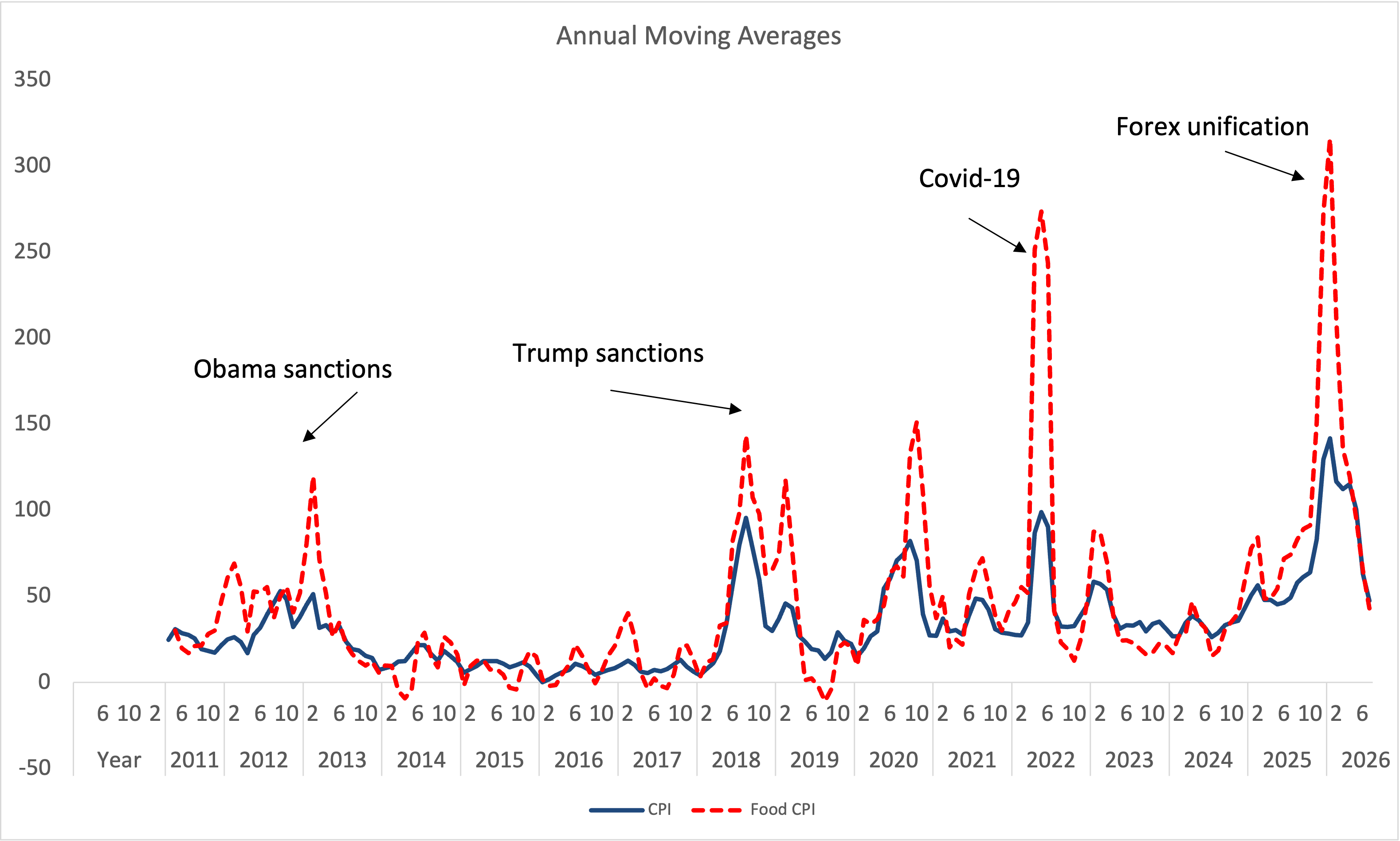
The unification removed the foreign-exchange subsidy covering roughly one-third of Iran’s imports. The price of the dollar for imports of food, medicine, and animal feed rose from the subsidized rate of 285,000 rials per dollar to roughly the free-market rate, which had climbed above 1,300,000 rials by January 2026. This more than fourfold increase in the rial cost of foreign exchange for essential imports is the main reason for the spike in food-price inflation in early 2026 visible in the graph.
The subsequent decline is important. The fact that inflation over the past two months has fallen back into the 40-percent range, rather than remaining at the triple-digit rates reached immediately after exchange-rate unification, is evidence that inflation is not runaway. The price-level shock from unification appears to be dissipating rather than turning into an explosive inflationary process.
What happens next, however, depends heavily on external developments, which can take control away from the monetary authority: how the war and blockade in the Persian Gulf evolve, and how much the newly tightened U.S. sanctions announced by Treasury Secretary Scott Bessent on August 24 constrain Iran’s foreign trade and access to foreign exchange. If these shocks substantially reduce Iran’s foreign-exchange earnings, the recent moderation in inflation may prove temporary.



leave a comment