Why Iran Has Avoided Hyperinflation—And Why That May Be Changing?
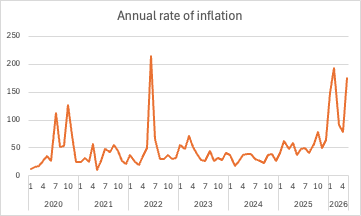
The inflation report for the Iranian month of Ordibehesht (21 April to 20 May) showed a significant rise in prices: 8.5 percent according to the Central Bank and 8.8 percent according to the Statistical Center of Iran. As the figure showing three-month averages indicates, these are record monthly inflation rates, equivalent to annual rates in excess of 150 percent. More importantly, they interrupt a three-month decline in inflation (at least according to the SCI data), which had raised hopes that the cost-push inflation resulting from last fall’s removal of foreign-exchange subsidies for food and medicine had largely been absorbed.
The sharp increase in prices last month inevitably revives concerns about hyperinflation. Such concerns have surfaced periodically in Iran’s recent history, but they have rarely been grounded in a careful understanding of what hyperinflation is. The casual use of the term often labels a few months of very high inflation as hyperinflation. Cagan (1956), however, defined hyperinflation as inflation exceeding 50 percent per month and treated it as a sustained process rather than a brief spike. Sargent (1982) went further, arguing that the essence of hyperinflation lies not in crossing a numerical threshold but in the breakdown of a state’s fiscal and monetary institutions.
That conclusion requires identifying a structural feature that can keep inflation at extremely high levels for prolonged periods. The political-economy literature offers a compelling explanation. In a divided polity where competing factions alternate in power, each has an incentive to redistribute resources toward its own supporters while spreading the inflationary costs across the broader public. Such dynamics make very high inflation more likely to emerge and more difficult to eradicate. This insight lies at the heart of influential contributions by Alesina and Tabellini (1990) and Alesina and Drazen (1991). Tornell and Velasco (1992) characterize the exploitation of the inflation tax as a classic tragedy-of-the-commons problem.
Iran’s long history of budget deficits points to persistent weaknesses in fiscal discipline. Yet fiscal imbalance alone is not sufficient to generate hyperinflation. Hyperinflation requires not only a loss of fiscal control but also a highly accommodating monetary authority willing to monetize deficits on a sustained basis. Such situations typically arise when competing political factions gain influence over monetary policy and use the central bank to finance spending that benefits their constituencies or serves short-term political objectives.
In societies where this free-rider problem is effectively constrained—as in the United States through constitutional checks and balances, and in Iran under the political dominance of the late Supreme Leader Ali Khamenei—the sustained fiscal and monetary breakdowns that produce hyperinflation are less likely to occur. Iran’s experience over the past four decades is consistent with this view: inflation has often been high, but it has not displayed the accelerating dynamics associated with hyperinflation (as the figure below makes clear).
Whether this argument still applies to Iran after the forty-day war and the assassination of the late Supreme Leader remains an open question. The central claim is not that Iran’s institutions were fiscally disciplined, but that the Supreme Leader’s political dominance limited factional competition over monetary policy, producing chronic but not accelerating inflation. If the war has weakened that central authority and increased competition among political, military, and economic factions—a possibility that cannot yet be assessed with confidence—the institutional constraints that previously limited excessive monetary expansion may have weakened as well. In that case, the risk of sustained monetary financing of fiscal deficits, and therefore of much higher inflation, would be greater than in the past.



leave a comment