Food Prices Surge in a Year Marked by War on Iran
Last week, the Statistical Center of Iran published its inflation report for Esfand (ending March 20), the final month of the Iranian year 1404. Despite the record-high inflation reported for the year, its most noteworthy fact is its release amid heavy bombing by the United States and Israel. It is a reminder of the resilience of the Iranian spirit—not only on the battlefield, but also in maintaining the state’s core functions on schedule. Perhaps more damaging than the destruction of the country’s physical capital is the erosion of its institutions, of which the production of accurate statistics—even when politically inconvenient—is essential and far harder to rebuild.
The report shows a sharp increase in the CPI—5.6% in Esfand alone (about a 92% annualized rate). This reflects the continued effects of exchange rate unification last November, compounded by wartime conditions that have prevailed since June. Inflation has accelerated over the past three months, reaching as high as a 193% annualized rate a month ago. As a result, point-to-point inflation for 1404 reached 90.2%, while average annual inflation—the more commonly cited measure—stood at 54.1%, the highest in recent memory.
Food prices led the increase, rising roughly sevenfold over the year, compared to a 90% increase in the overall price level. This divergence is largely explained by the elimination of foreign exchange subsidies for food and medicine, as well as increased public expenditures associated with the war. When food prices rise faster than overall prices, the result is typically higher poverty rates and worsening income distribution. The unyielding and fast rising food prices during the year likely forced most households to increasingly cut back on non-food expenditures, mounting the pressure of inflation.
Food prices led the increase, rising roughly sevenfold over the year, compared to a 90% increase in the overall price level. This divergence is largely explained by the elimination of foreign exchange subsidies for food and medicine, as well as increased public expenditures associated with the war. When food prices outpace general inflation, poverty rises and income distribution deteriorates. The persistent surge in food prices likely compelled households to reallocate spending away from non-food items, adding to the pressure of inflation.
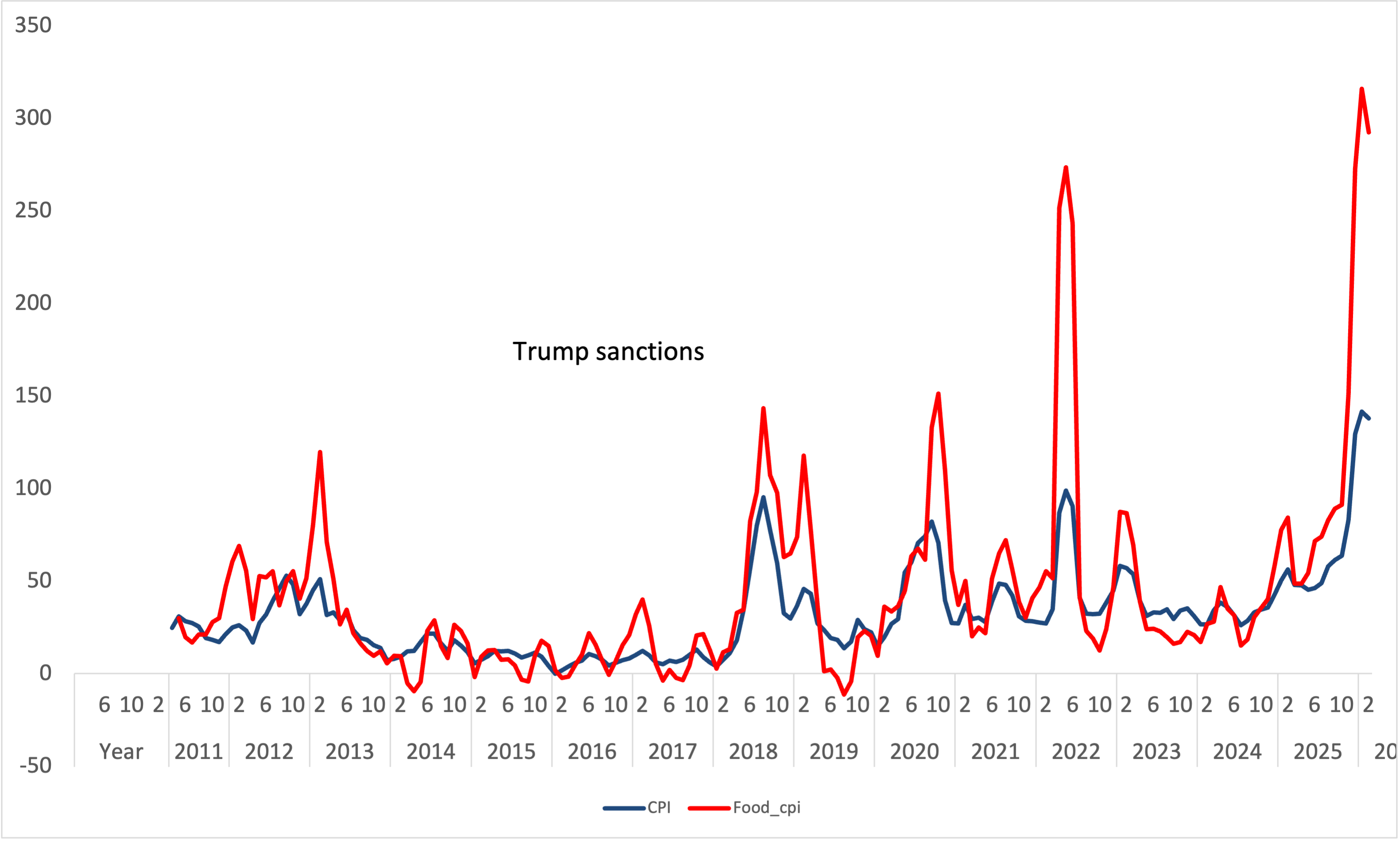
Looking back at inflation over the year, the draft budget for 1405—unveiled last fall and proposing an average wage and salary increase of just 20%—now appears highly unrealistic. Although it was later adjusted upwards, the initial disconnect between nominal wage adjustments and actual inflation is one of the factors that others and I have noted behind the protests that fueled the December 28 protests.

 Tyranny of numbers
leave a comment