Inequality of income in Iran after subsidy reform: the view from the Palma ratio
A while back a friend asked me if the Palma ratio — the ratio of the incomes of the top 10% to the bottom 40% — is a good indicator of inequality in Iran. I waited until I had the data for 1392 (2013/2014) to answer his question. In the meantime, I came across a banner headline in the economics newspaper, Taadol, which read something to this effect: “Subsidy reform deepens inequality.” The claim itself was nothing new, but the reported Gini indices were: I had not seen anyone report Gini coefficients as high as 0.53 for the post-revolution Iran, and it turns out that they do not exist.
Reading Piketty in Tehran
If you are someone who pays attention to economic news and have not been hiding in a cave for the past few months, you must have heard of the famous book by the French economist Thomas Piketty, Capital in the Twenty-First Century. Since its translation was published in English earlier this year, it has sold more than half a million copies, which is astonishing for a book with many tables and charts (a publisher once told me that each chart cuts sales by 10% — there goes that bit of wisdom).
Last month people were also talking about Piletty’s book in Tehran, and this month’s Mehrnameh, published this week, has a section discussing it, including a short interview by yours truly. I must confess, as I did to the interviewer, that like most people who have bought the book, so far, I have only read the introduction (I have read, however, many of the book reviews — more pages of reviewes than of the book itself! Read an excellent early review by Branko Milanovic here). (more…)
Inflation and energy price reform in Iran
The dominant view of the high inflation of the last three years blames it on the subsidy reform. (The latest high profile assertion to this effect came from a piece by Hashem Pesaran and Hadi Salehi Esfahani published by the Fars News Agency, to which Mohammad Ali Farzin, the former head of the subsidy reform program, responded by claming that only 10% of the inflation was due to the subsidy reform). Were it not for the fact that blaming energy prices for the destructive inflation of the last three years casts a long shadow over future policy on energy prices, the mere fact that it is wrong would not prompt me to bore the readers of this blog with yet another post on inflation. (more…)
Transfers in kind: learning the old lessons, again
President Rowhani has received well-deserved high marks in foreign policy for his management of the tough negotiations with P5+1 in Geneva, but his first attempt at dealing with Iran’s broken social protection system does not deserve a passing grade. I explain this in my latest post at Iran Matters. The food distribution plan that, according to an editorial in the conservative Keyhan newspaper, “could have been a gesture that the government cares about the poor … but instead it turned into insult and humiliation.”
The government seems to have made a hasty decision that transfers in kind are superior to cash, despite evidence to the contrary, as I argued in a recent post here. Tadbir, which is the motto of Rouhani’s government and translates into prudence and experience in Persian, should include economics research and the experience of other countries. Are there channels for this type of information to find its way into Iran’s policy circles?
Saving the subsidy reform program
Ever since it took over the reigns of government in August, President Rouhani’s administration has been grappling with the challenge of closing the huge gap in the government budget that it has inherited from its predecessor, reportedly at about 800 trillion rials (about $33 billion) or more than one third of planned expenditures. This is no small challenge given the fact that half of the year is over and much of the expenditures have already taken place or been committed. So, to reduce the deficit the government has little choice but to raise revenue. Luckily, inflation started to slow down just before Rouhani took over and has stayed below the 20% annual rate for the last three months, down from twice that rate in previous months. The bad news is that the most praiseworthy of the Ahmadinejad programs, the subsidy reform, is in deep deficit. The program has other problems besides its revenue gap, but it is on life support and the chord will be cut unless this problem is taken care of. Good solutions are there, all involving further adjustment in prices, but to implement them the government needs to show courage. The idea that has been floating for some time to cut the payments to richer consumers is appealing but not practical.
(more…)
Debating the economy in Iran’s presidential election
One of the weakest aspects of Iran’s presidential election is fact checking for economic claims made by the candidates. For example, the other day candidate Gharazi seemed to imply that as Minister of Oil for the Rafsanjani government in the 1990s he was responsible for keeping the world price of oil high. He claimed that the world oil price dropped by about 50% when president Khatami replaced him by a reformer. It is a tall claim that a minister responsible for less than 5% of the world oil supply could have such a large influence on the global market.
Mr. Rezai made a similar exaggeration when he said the rial has lost two-thirds of its value since last year. True, in the free market for foreign exchange the rial fell by two-thirds last year, but prices have not tripled, as his remark implied. This is because imported goods account for only a proportion of consumer goods, and not all imports are bought with this rate.
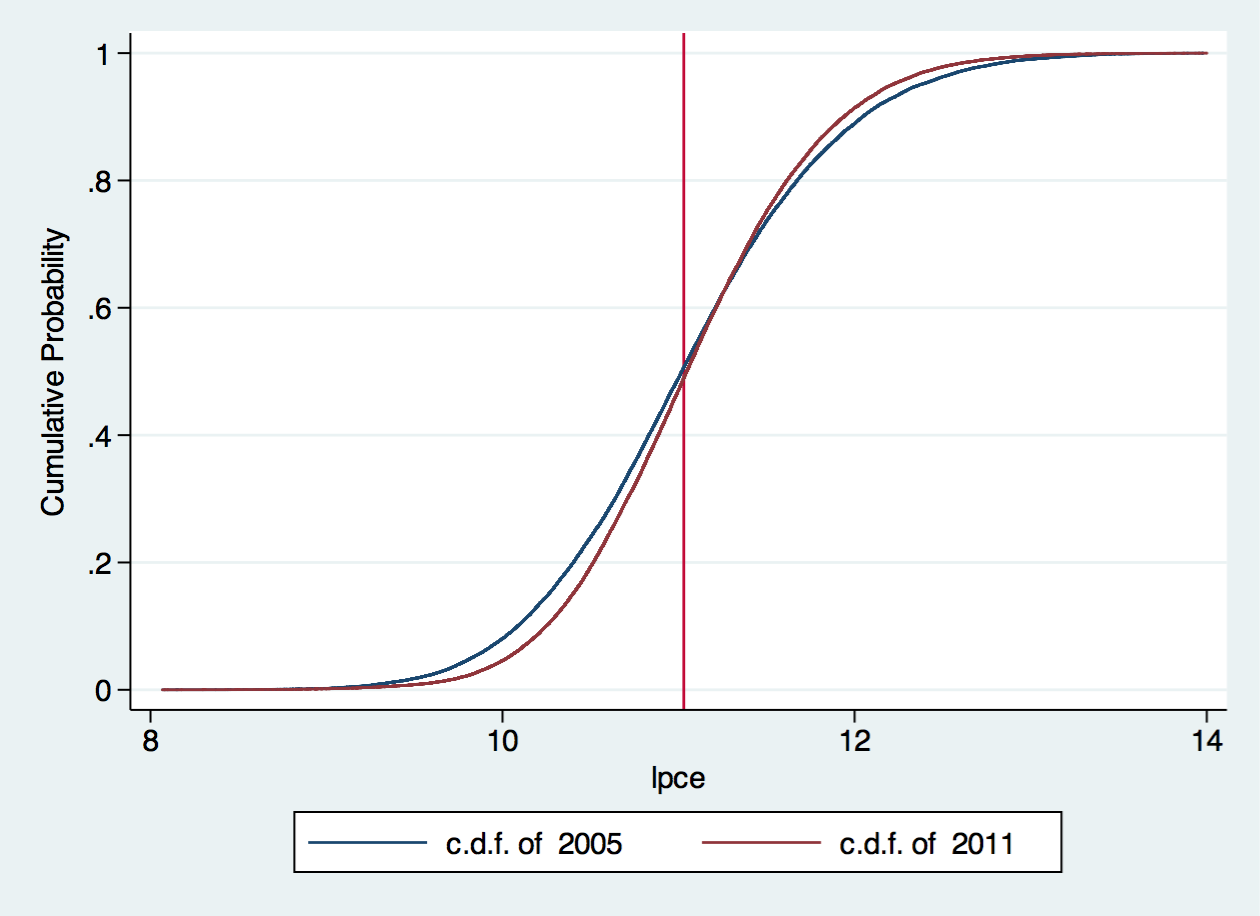
But perhaps the prize for exaggeration goes to Mr. Aref, the reformist candidate, for claiming that 44% of Iranians are poor. If you assume that the 44% poverty rate also held for 2011, the last year for which Iran’s Statistical Center has released the raw data, it is easy to deduce the level of per capita expenditures (pce) that he has in mind as the poverty line. It is a whopping 61,500 rials per day (roughly $12 using the World Bank PPP rate of 5006 rials per USD for 2011). Unfortunately for Mr. Aref, the same poverty line implies a higher poverty rate for 2005 (47%), the last year of the reformist government in which he served as vice president.
Of course, these outcomes are not entirely the result of government policies, and Iran’s economy faces different challenges in 2011 than it did in 2005. But such cavalier use of data by politicians is not becoming for a country that claims to have reached a high level of scientific maturity and which wants to take its electoral process seriously.
The graph of the cumulative distribution functions of the pce for 2005 and 2011 also show that if we pick a lower poverty line, one more in line with international standards, of about $4, or 22,000 rials, we we notice a larger drop in poverty, from 7.1% to 4.3%. The cdf’s also show a decline in inequality. This is most likely the result of the cash transfer program administered under the Ahmadinejad government. Whether or not this was the best way to help the poor is another matter. I have been critical of his liberal import policy that hurt the Iranian economy during these very years, but that criticism is based on the poor losing jobs, not cash. I happen to believe that giving the poor work is much superior to giving them cash, but then that is a debate for another time.
Iran’s Inflation showing signs of moderating
The Central Bank of Iran has just released the Consumer Price Index for the month of Azar (ending on November 20, 2012), and it shows a much smaller increase in prices than the previous two months. The index rose by about 4.5% per month during the last two months (equal to 70% annually), but its pace moderated in Azar, rising by 2.5%. This is still a sizable increase (about 35% annually), but it may be a sign that the large devaluation of the rial during the last week of September has run its course and consumers maybe back in the territory that, unfortunately, they have come to regard as normal: prices rising by about 20% per year. This is, of course, conditional on no new shocks happening to the exchange rate or the money supply in the near future. (more…)
Iran’s subsidy reform survives crucial hurdle
What is described as the second phase of Iran’s Targeted Subsidy Program appears to be on its way to implementation after the parliament approved to increase the size of the program to 660 trillion rials (about $54 billion using the official exchange rate), denying the government its request for a much larger program (1,350 trillion or $100 billion). The compromise allows the government to increase prices of subsidized goods and at the same time raise the monthly payment of cash to families by an as yet undetermined amount. Some reports suggested that the current cash rebate of 450,000 rials per person per month could increase by as much as one third for the remainder of this year, which ends on March 20, 2013. The timing of the second phase is unknown but there is no doubt that it will happen. Getting the parliament to authorize the second phase means that the subsidy reform program has passed a crucial test, all the more because the economy is under stress from the effects of past inflation, sanctions, and general macroeconomic mismanagement. The critics who wanted to stop the program on its tracks have had a field day in pinning various failures onto the reform program. For the time being they seem content with having slashed its extravagant proposed budget. (more…)
Anniversary blues for subsidy reform
The anniversary of the subsidy reform, on December 20, 2011, arrived with fireworks, but not the kind the government had hoped for. In a day that President Ahmadinejad was addressing a conference of the first anniversary of the subsidy reform in Tehran, the rial fell by more than 5%, breaching the psychological 15,000 rials per dollar barrier. These two events are more than coincidentally connected. The rial has been weakened by the inflation unleashed by the subsidy reform, a cost of the reform that was both foreseen and justified. At the same time, the precipitous devaluation of the rial adds to uncertainty and macroeconomic instability that can undermine the subsidy reform. The real benefit from the reform derives from reduced demand for energy, which can only happen if households and firms are willing to change their behavior and invest in energy saving equipment, which in turn requires confidence that the post-reform energy prices will not be washed up in some cycle of inflation and devaluation. Remember, unsubsidized energy prices are equal their world prices multiplied by the exchange rate. With 15,000 rials to the dollar, gasoline (at 4000 or 7000 rials per liter) is 50% cheaper than it was a year ago when the new price was set, and is once again subsidized. (more…)
Iran’s place in the world distribution of income: an update
My post by the same title a year ago that featured a graph developed by Branko Milanovic was the second most visited post on this blog last year (after one on Iran’s energy subsidies), receiving 912 views. So when I learned last week that he has been working on an update of his analysis of the world distribution of income, I requested an updated graph. Branko was the keynote speaker at an Economic Research Forum conference that I attended in Cairo, where he was introduced as “Mr. Inequality”. His new results show that Iran’s position in the world distribution of income improved between 2005 and 2008, something that should surprise no one since during this period Iran was the recipient of about $200 billion worth of transfer from the rest of the world as oil income. (more…)

 Tyranny of numbers
6 comments