The economics of negotiating with the West
I published this post on Lobelog today in which I raise a theme familiar to the readers of this blog: there is a deep misunderstanding of Iran’s economy in the West, exemplified by a NY Times story of last week that invoked the “collapse scenario.” I have been hearing the “collapse” theory of Iran’s economy lately, something that I thought people gave up after the economy recovered (sort of) from the huge shock of the rial devaluation last October. Inflation is coming under control and unemployment has a real chance of declining thanks to a producer oriented (as opposed to merchant-oriented) Rouhani administration.
But years of negative reporting on the economy (“inflation and unemployment are always double what official data say”) had created the impression of a teetering economy and the temptation in the West to be tough with Iran and extract more concessions. I argue that this could be a big mistake and shows ignorance of the facts about Iran.
Returning to the global economy, this time as producer rather than shopper, is extremely important for the future of the country. The time is right in many ways, and Rouhani’s team have done a good job to show they are serious about rapprochement with the US, but the more charm is brought in the more people think Iran is desperate and the less the West should change its position. At the center of this is the lack of a credible story about the dynamics of Iran’s economy. How bad is it really and where is it heading.
The freeze on national income data in the last few years has hampered the effort to put such a story together for Iran. The online data banks of most government agencies (Iran’s Statistical Center and the Central Bank, in particular) have little new data past 2008. Numbers are slowly coming out in the Persian-language press in Iran, but unless they are available in English, it is difficult to make the case that Iran’s economy is not about to collapse and the West should approach these negotiations wisely.
Inflation is down but hold the cheer
The latest inflation figures for the Iranian month of Mordad that ended on August 20 show that the Consumer Price Index (CPI) rose by a modest 1.16%, which translates into an annual rate of 14.9%, or less than half of the recent annual rate of inflation. The month before prices rose at an annual rate of 18.4%, which is also way down from the 49.7% increase Iran experienced in June. (more…)
Rising unemployment and joblessness, 2006-2011
The performance of the outgoing Ahmadinejad administration is in large part tied to its record of job creation during his tenure. Just before the presidential election, Professor Masoud Nili of Sharif University, one of Iran’s most prominent economists, created a stir when he criticized, on national television, this record. His claim of near zero net new job creation between the census years of 2006 and 2011 was considered controversial but it should not have been because he was basically reading the numbers off the census tables. (more…)
Evaluate policies, then politicians
I have long been thinking to write something in this blog about the confusion in Iran between criticizing policies and politicians. If Ahmadinejad is bad, then every policy he implements must be bad (like subsidy reform) and if a president is good he can do no wrong (the wasteful $1.2 billion job creation program under Khatami). Today, I opened an article in Al Monitor entitled, “Ahmadinejad Takes Parting Shot At Iranian Women,” and was much surprised to learn about the parting shot. Apparently, the outgoing president has angered activist women by proposing a bill that would reduce the working hours for women to 36 hours per week while paying them for 44 hours, or if they work the full 44 hours, they get two additional paid days off per month. How will this hurt women? According to the article, “women’s rights activists believe this bill is another attempt by Ahmadinejad to dramatically reduce women’s participation in the workforce.” I am not sure about the intention part but I do agree with the conclusion. Most economists would argue that an attempt to raise hourly wages by reducing working hours while keeping pay constant would cause employers to favor men in hiring, which would hurt women’s employment. (more…)
Debating the economy in Iran’s presidential election
One of the weakest aspects of Iran’s presidential election is fact checking for economic claims made by the candidates. For example, the other day candidate Gharazi seemed to imply that as Minister of Oil for the Rafsanjani government in the 1990s he was responsible for keeping the world price of oil high. He claimed that the world oil price dropped by about 50% when president Khatami replaced him by a reformer. It is a tall claim that a minister responsible for less than 5% of the world oil supply could have such a large influence on the global market.
Mr. Rezai made a similar exaggeration when he said the rial has lost two-thirds of its value since last year. True, in the free market for foreign exchange the rial fell by two-thirds last year, but prices have not tripled, as his remark implied. This is because imported goods account for only a proportion of consumer goods, and not all imports are bought with this rate.
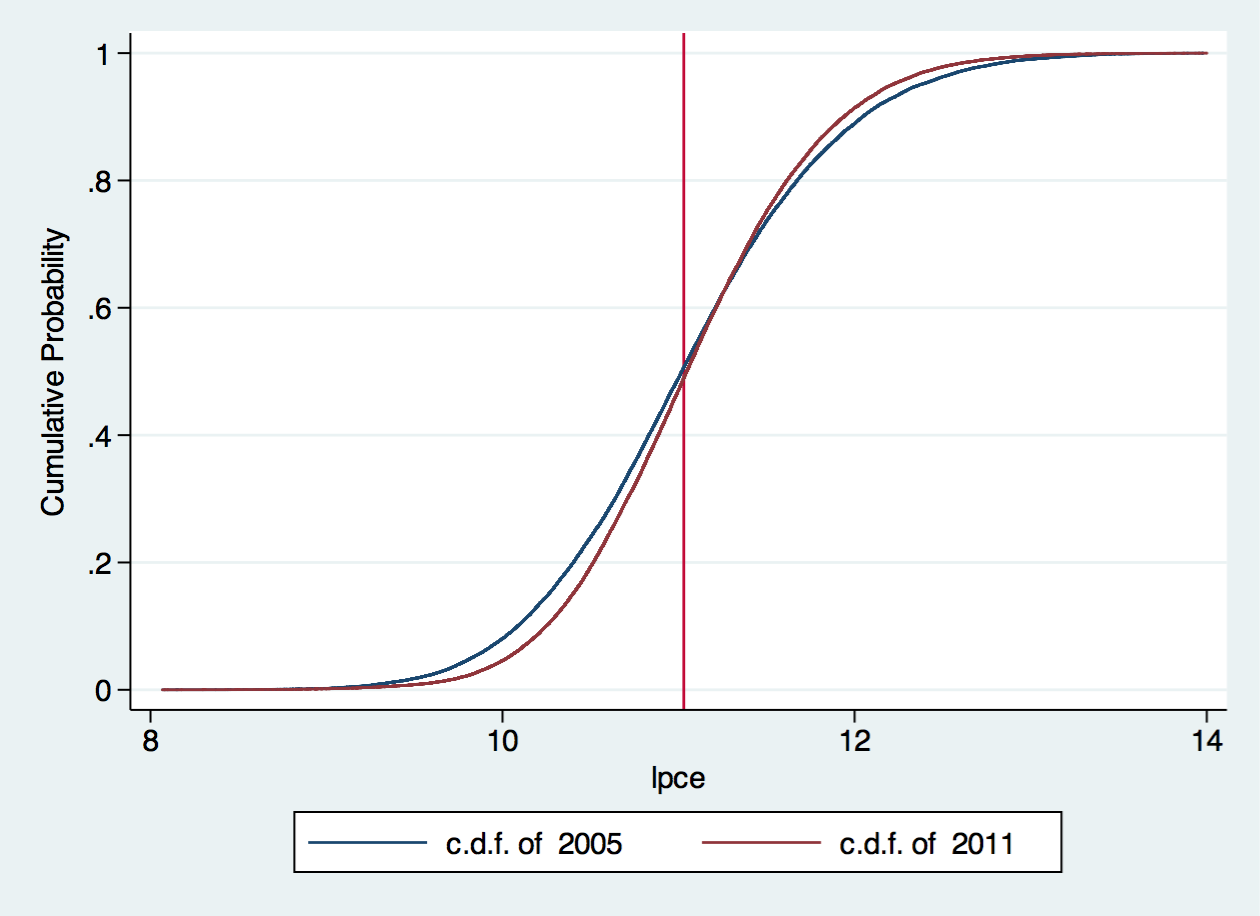
But perhaps the prize for exaggeration goes to Mr. Aref, the reformist candidate, for claiming that 44% of Iranians are poor. If you assume that the 44% poverty rate also held for 2011, the last year for which Iran’s Statistical Center has released the raw data, it is easy to deduce the level of per capita expenditures (pce) that he has in mind as the poverty line. It is a whopping 61,500 rials per day (roughly $12 using the World Bank PPP rate of 5006 rials per USD for 2011). Unfortunately for Mr. Aref, the same poverty line implies a higher poverty rate for 2005 (47%), the last year of the reformist government in which he served as vice president.
Of course, these outcomes are not entirely the result of government policies, and Iran’s economy faces different challenges in 2011 than it did in 2005. But such cavalier use of data by politicians is not becoming for a country that claims to have reached a high level of scientific maturity and which wants to take its electoral process seriously.
The graph of the cumulative distribution functions of the pce for 2005 and 2011 also show that if we pick a lower poverty line, one more in line with international standards, of about $4, or 22,000 rials, we we notice a larger drop in poverty, from 7.1% to 4.3%. The cdf’s also show a decline in inequality. This is most likely the result of the cash transfer program administered under the Ahmadinejad government. Whether or not this was the best way to help the poor is another matter. I have been critical of his liberal import policy that hurt the Iranian economy during these very years, but that criticism is based on the poor losing jobs, not cash. I happen to believe that giving the poor work is much superior to giving them cash, but then that is a debate for another time.
Inflation reporting in Iran
The statistics most readily available for Iran are about prices, yet they are seen as the least believable. Last week the Statistical Center of Iran that reports on unemployment, household budget and national income, and now claims to be the official source for reporting on inflation, published a report providing us with detailed information on prices for the last six years (2007-2013). It shows that the consumer price index (CPI) rose by 40.6% during the Iranian year 1391 (21 March 2012 to 20 March 2013), and the average index for 1391 was 31.5% above 1390. The former is the point to point inflation, what people feel, and the other is what is officially reported as the years’ inflation. (more…)
Inflation and money supply in Iran: a closer look
Last week, in a post on the Lobelog.com I noted further signs of moderating inflation. Prices in the Iranian month of Dey (ending 20 January 2013) rose by 1.7%, compared to 2.5% the month before and 4.5% per month in the previous two months after devaluation. These are high rates of inflation on an annual basis (see chart below), but a sign that the Central Bank may have found a way to keep the growth of money supply below the rate of inflation. I was curious enough if this were the case to look up money supply data published by the Central Bank and here is what I found. For the quarter that ended on December 20, 2012, which covers the three month period after devaluation, the rate of growth of money supply was 20 percentage points below the rate of inflation. (more…)
Iran’s hyperinflation myth
I just published a short piece in Al Monitor to refute the widely held belief that Iran has been experiencing hyperinflation. As I explain there, the myth originated in the application of textbook economics of hyperinflation to Iran, not taking into account two important facts. First, that the Iranian government does not have to print a lot more money just because the free market rate for the dollar tripled. This is because it sells foreign exchange, not buy it. If the government had to buy its foreign exchange from private exporters, then to manage its operations it would have to print money at an accelerating rate to meet its obligations. Second, because the government is the main supplier of foreign exchange, and is therefore a price maker, not a price taker, it can price discriminate, and sell forex at different rates (three rates now). Of course, there are limits to its price making ability. It can pour more money into the free market and lower the rate there, or sell more at the subsidized rate of 12260 rials per $ to keep inflation down. But since it has a limited (and shrinking) supply of foreign exchange, mainly thanks to the sanctions, it has to be careful how it uses its forex. If the Central Bank tries to feed capital flight or speculation (as in did in the early 1990s), it may look in charge for a while but soon will be sorry. (more…)
How large has been rial’s recent devaluation?
Iran’s multiple exchange rate system which has been in effect since last October has led to much confusion about the new dollar parity for the rial. Most people in Iran consider the “free” or parallel market rate, which has fluctuated around 30,000 rial per USD, as the new equilibrium exchange rate. Published Western reports have used a similar number. For example, an article in Foreign Policy last month put the decline in the value of the rial at 300%, which is not easy to interpret but probably means 3 times what it used to be a year ago (around 10600 rials per $), or about 30,000. A story in Washington Post yesterday noted that the rial had declined by more than 40 percent relative to its value in August — again, around 30,000 rials per $ since the free market rate in August was around 19,000 rials. A Reuters report today used the exchange rate of 30,000 to convert rials into USD. But has rial really fallen by this much? (more…)
Prices in Iran and what they mean for the PPP exchange rate
As I have argued in this blog and elsewhere, there is not a single equilibrium exchange rate for the rial. If you believed my rough calculations in my previous post, and if you needed to report only one number, the exchange rate would be something around 20,000 rials per dollar (about 96.5% increase over the old exchange rate of a little over 10,000). The next best thing after an equilibrium exchange rate (ER), one that is actually more useful for welfare comparisons, is the Purchasing Power Parity ER. Here are my back-of-the-envelop calculations of the PPP rate for Iran in 2012.

 Tyranny of numbers
3 comments